THE COAST · KILL DEVIL HILLS
The Wright Brothers National Memorial at Kill Devil Hills
Photographs: ERB.John, Wikimedia Commons, CC BY-SA 3.0 · Myoder006, Wikimedia Commons, CC BY-SA 4.0 · LknTom, Wikimedia Commons, CC BY-SA 4.0
The Coast · landmark 13 of 21
The field on the Outer Banks where Wilbur and Orville Wright made the first sustained, powered flights on December 17, 1903, with the four landing points marked in stone, the camp rebuilt, and a granite tower on the dune where they learned to glide.
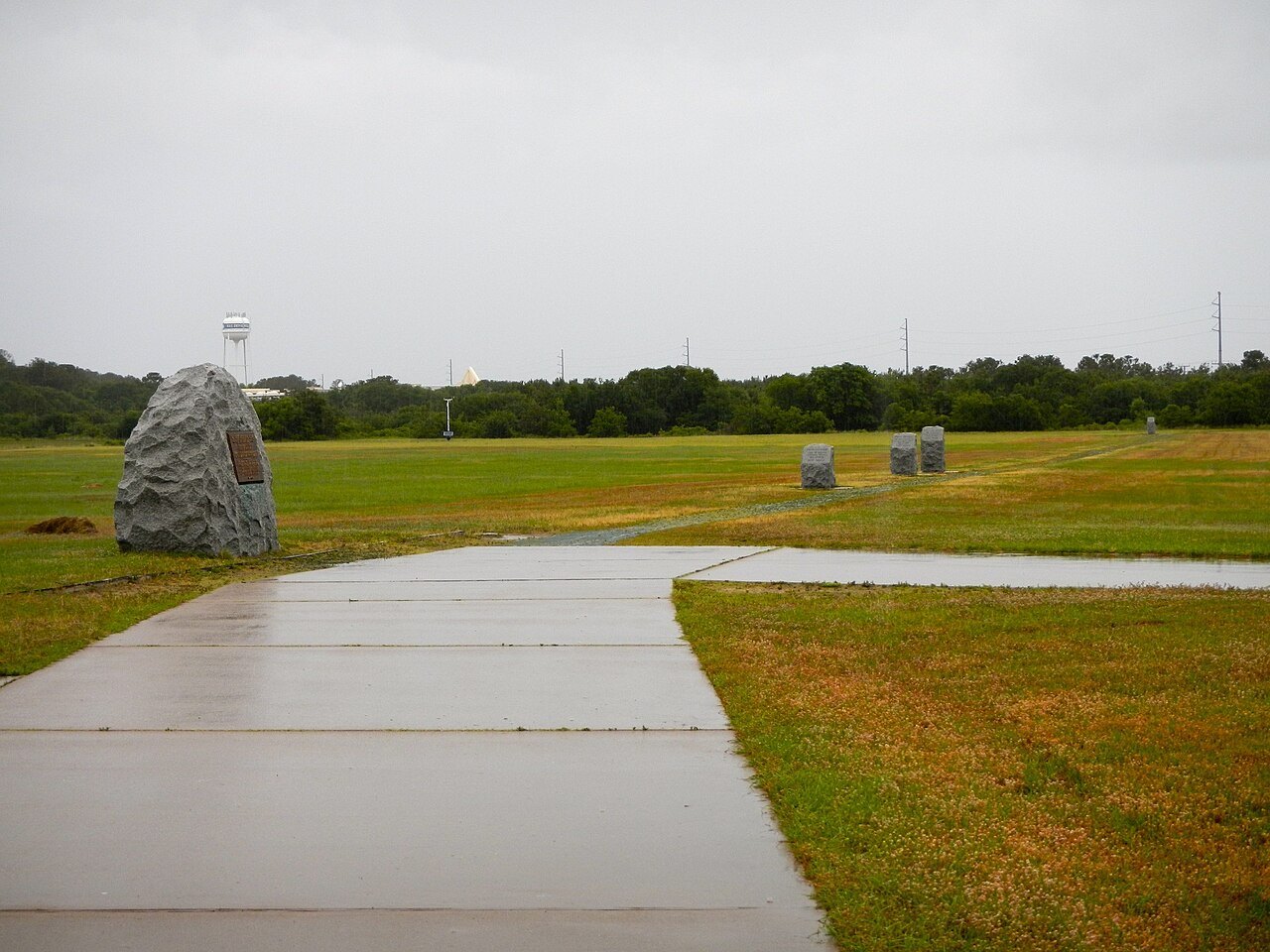
- The First Flight boulderThe stone at the start of the rail, with markers where each of the four flights came down.
- The campTwo wooden sheds rebuilt from photographs: the first airplane hangar and the brothers' living quarters.
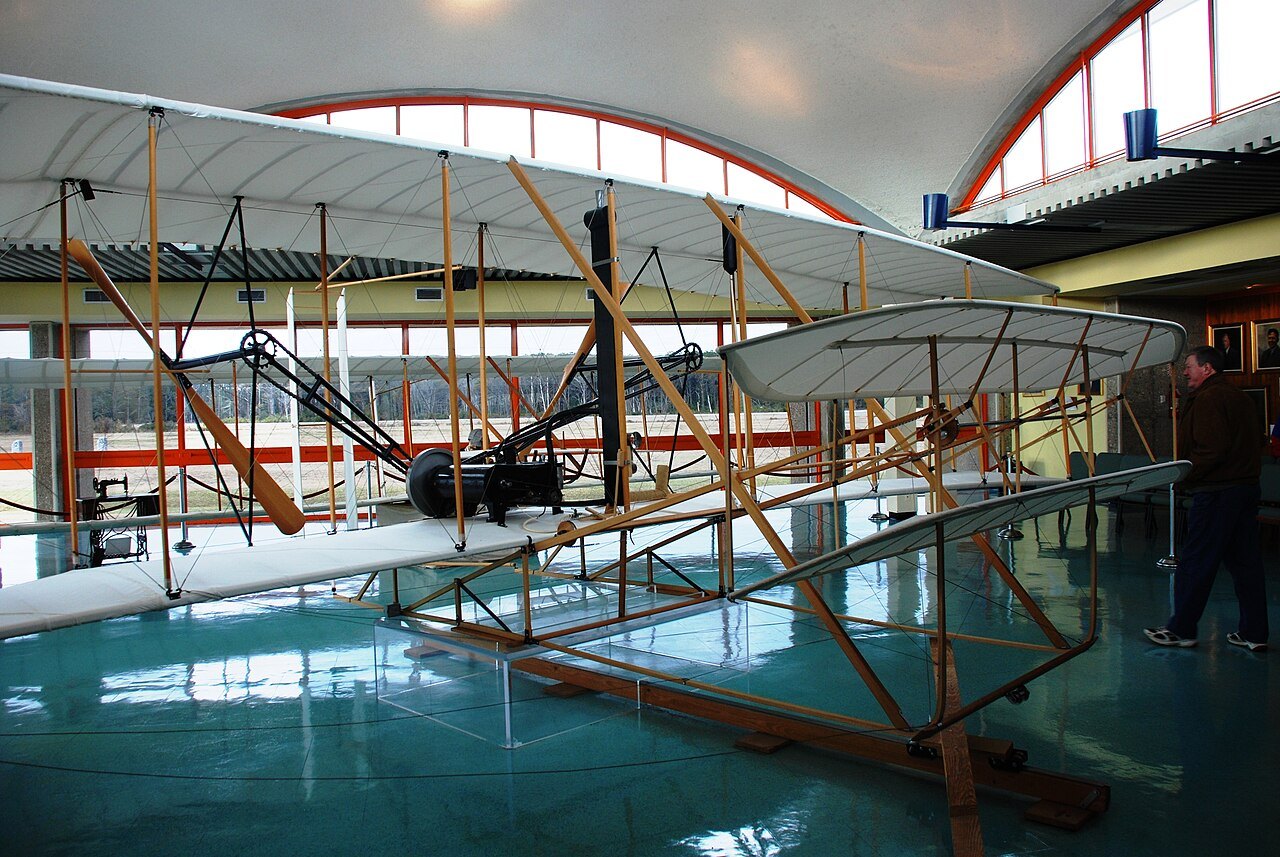
- The Flyer replicaA life-sized copy of the 1903 Flyer in a wing of the visitor center.
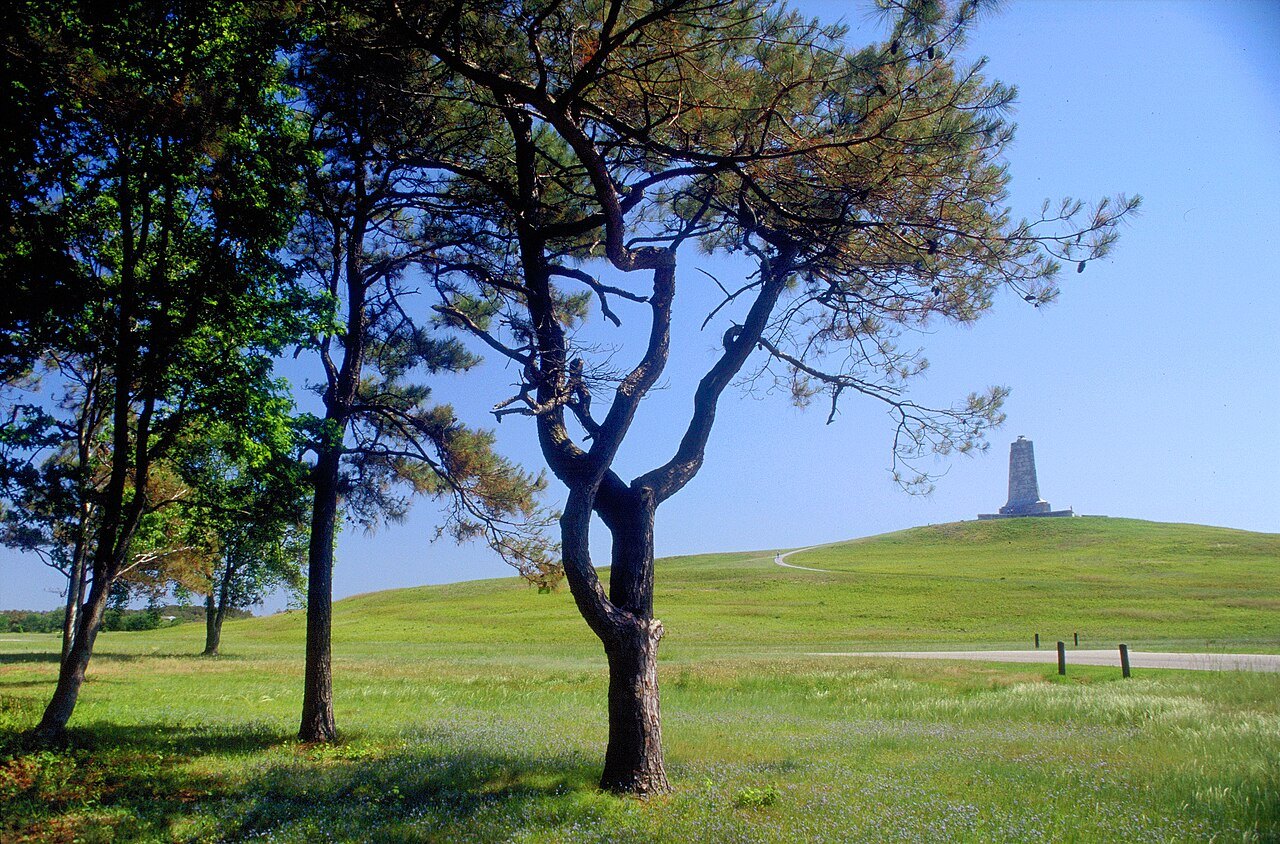
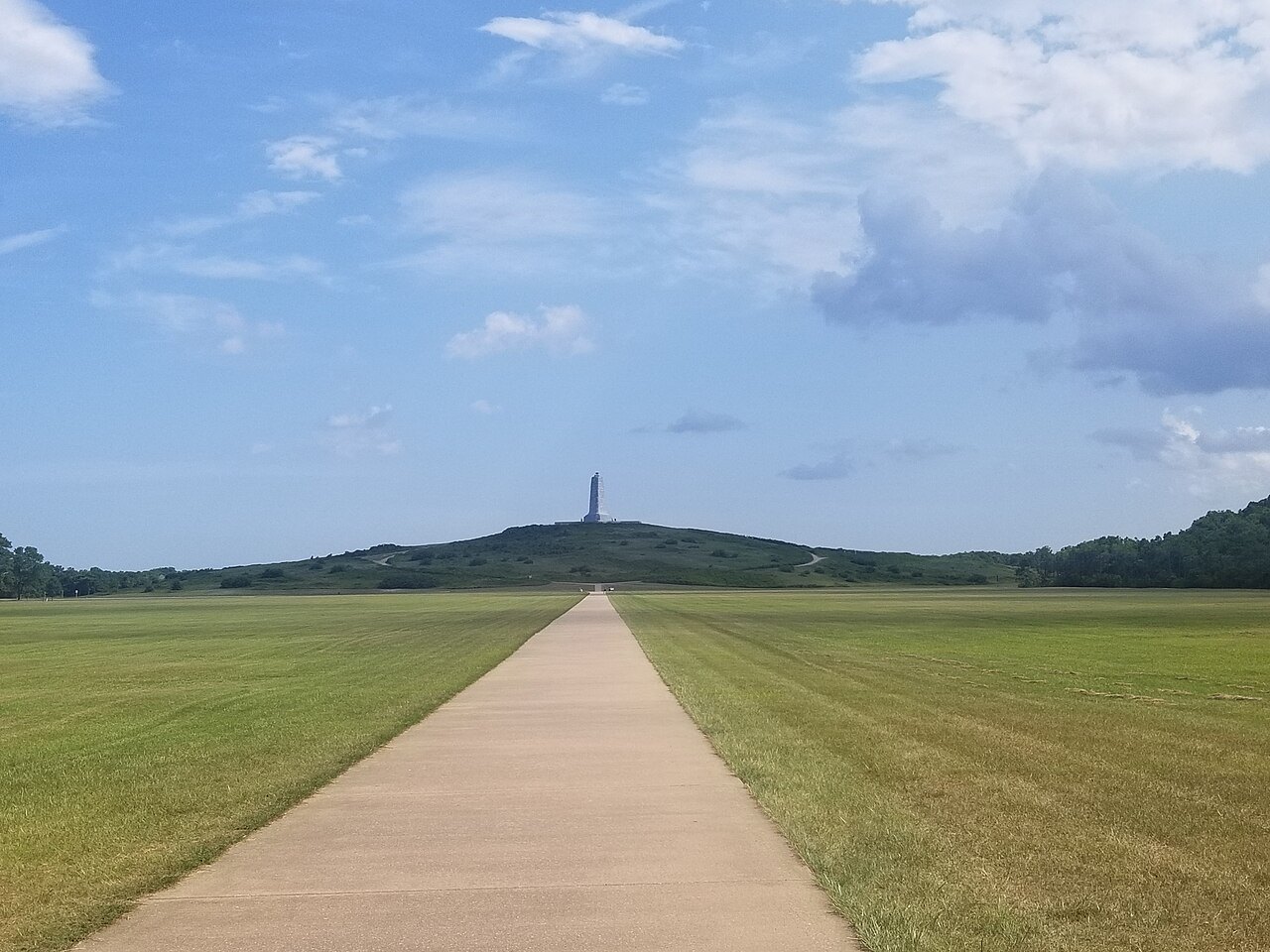
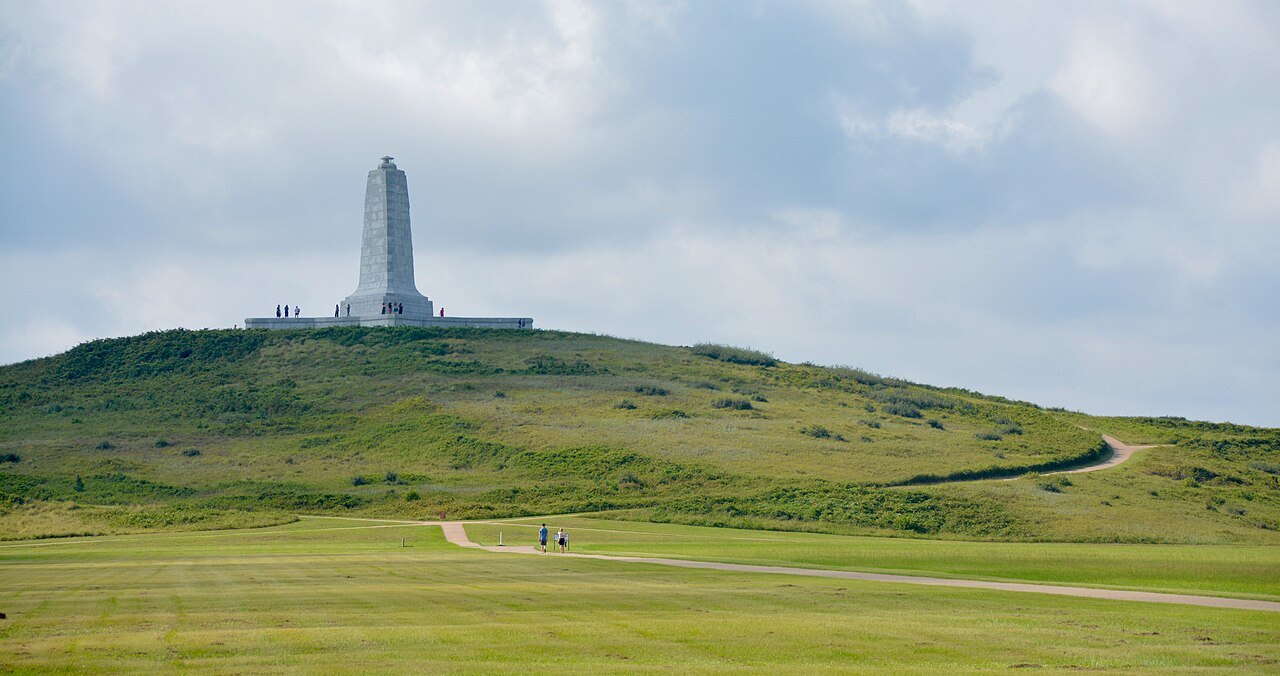
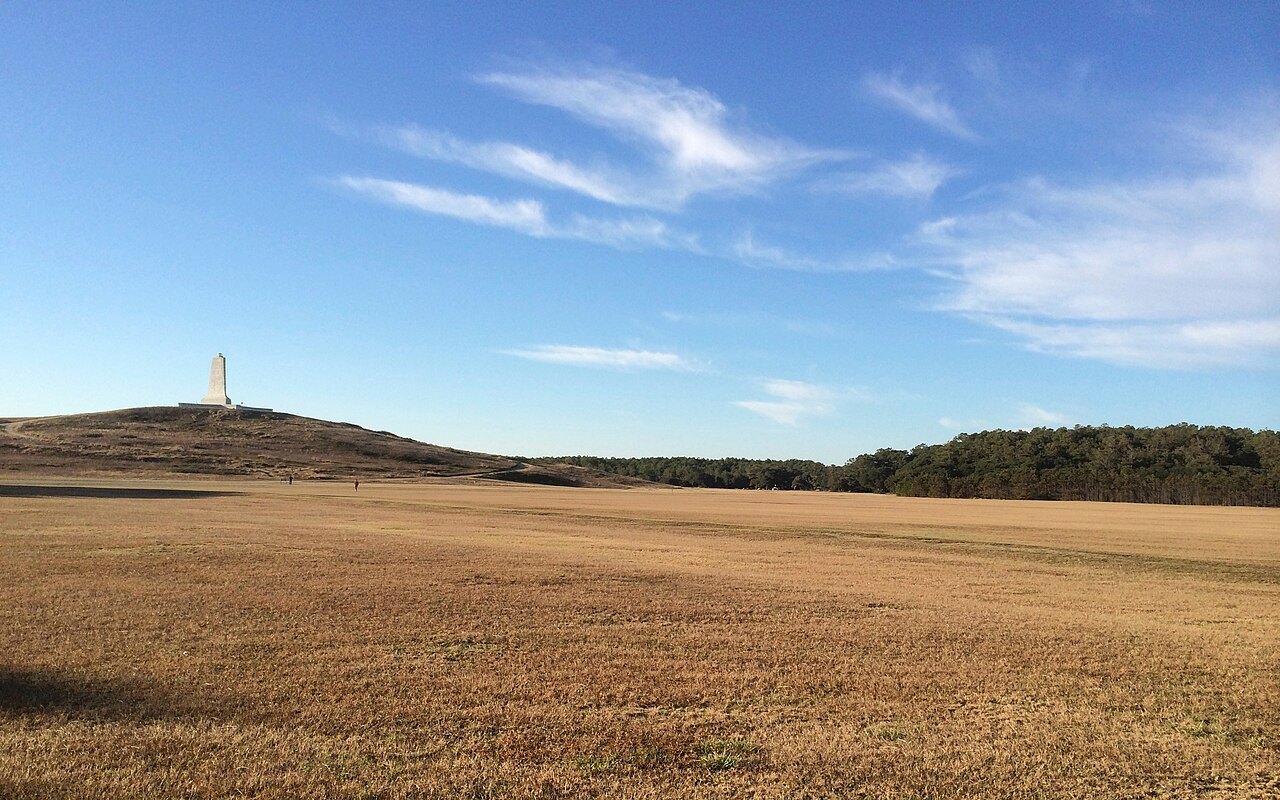
- Kill Devil HillThe ninety-foot dune of the glider tests, grassed over and topped by the granite memorial tower.
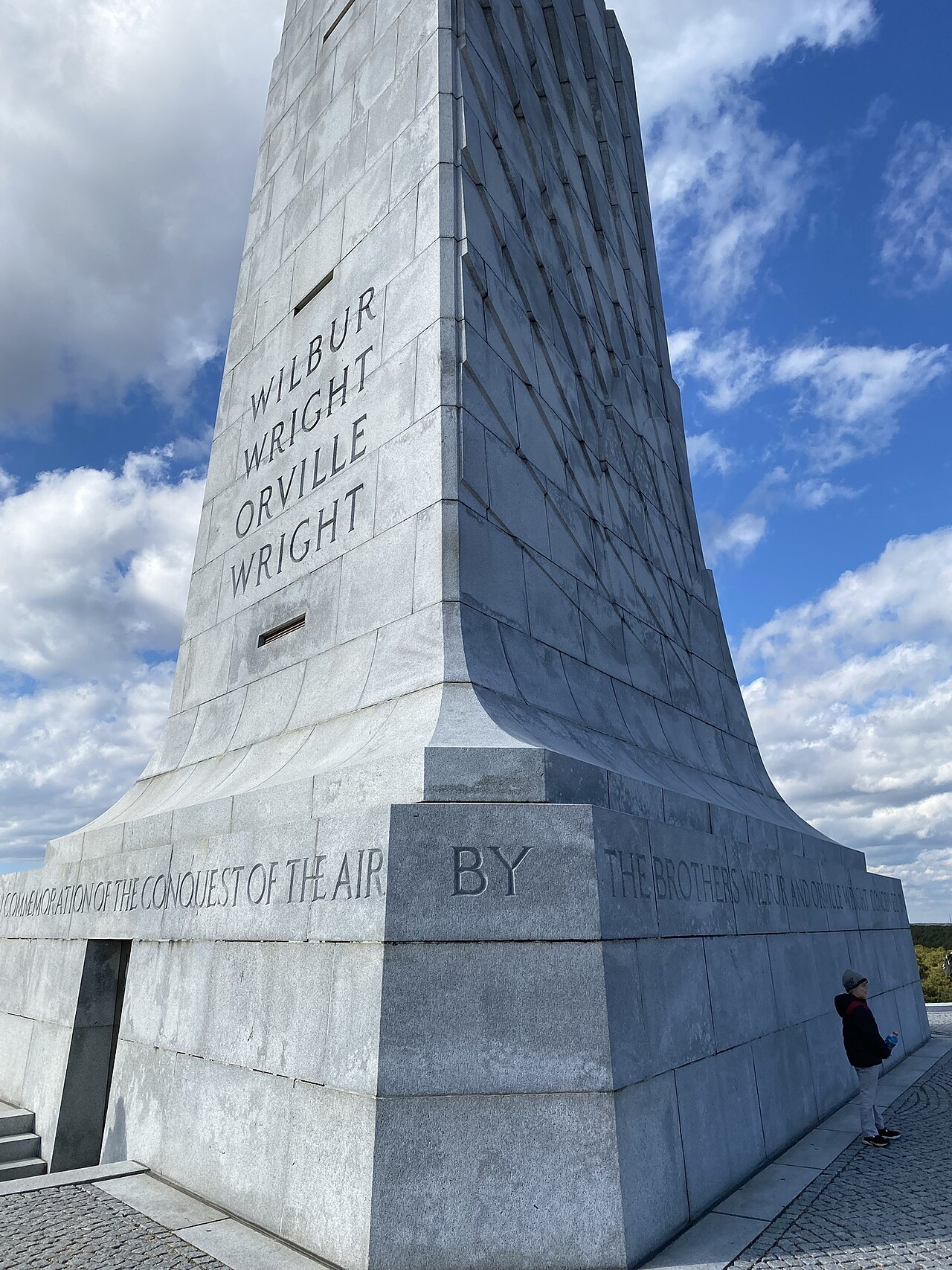
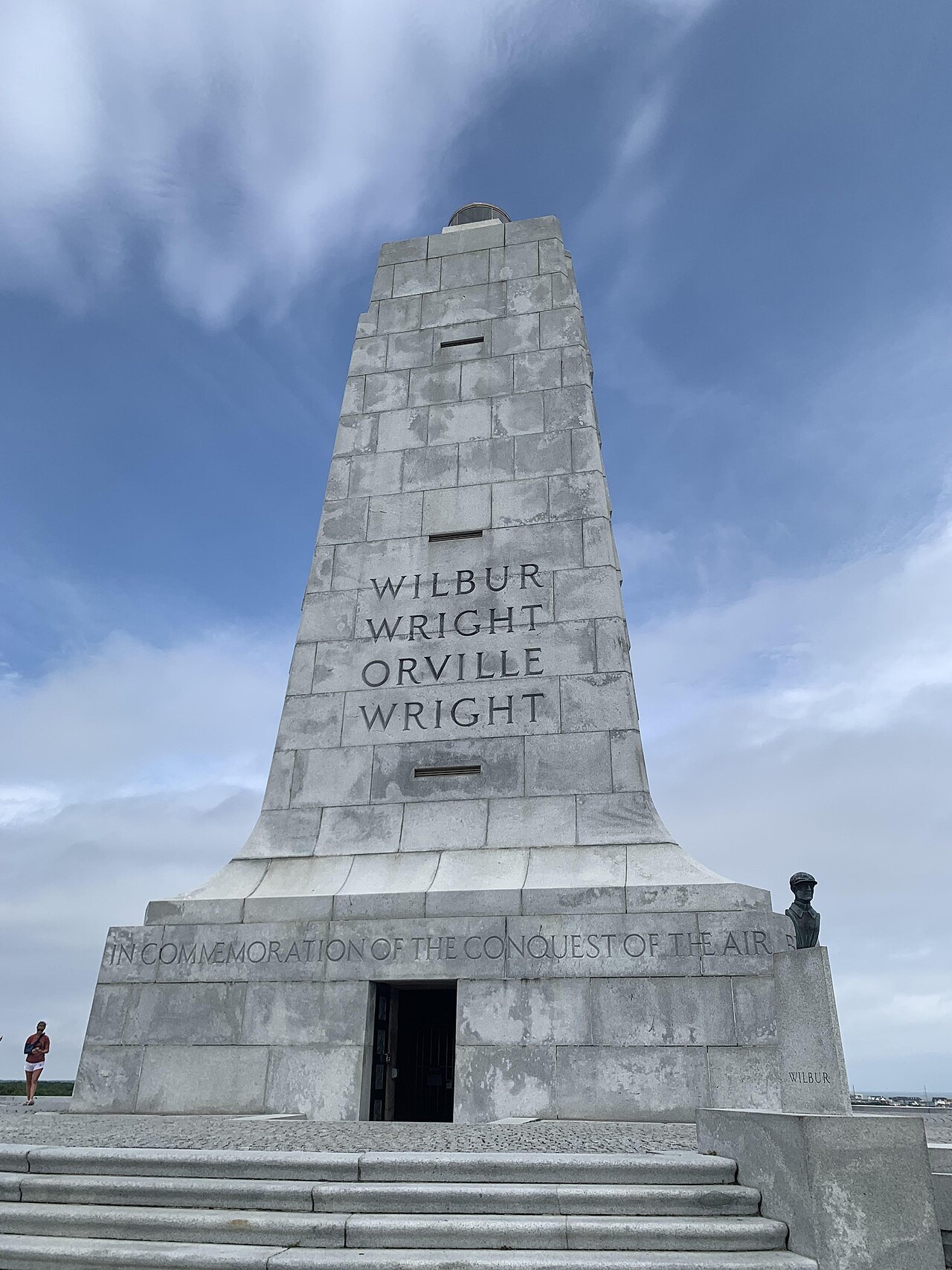
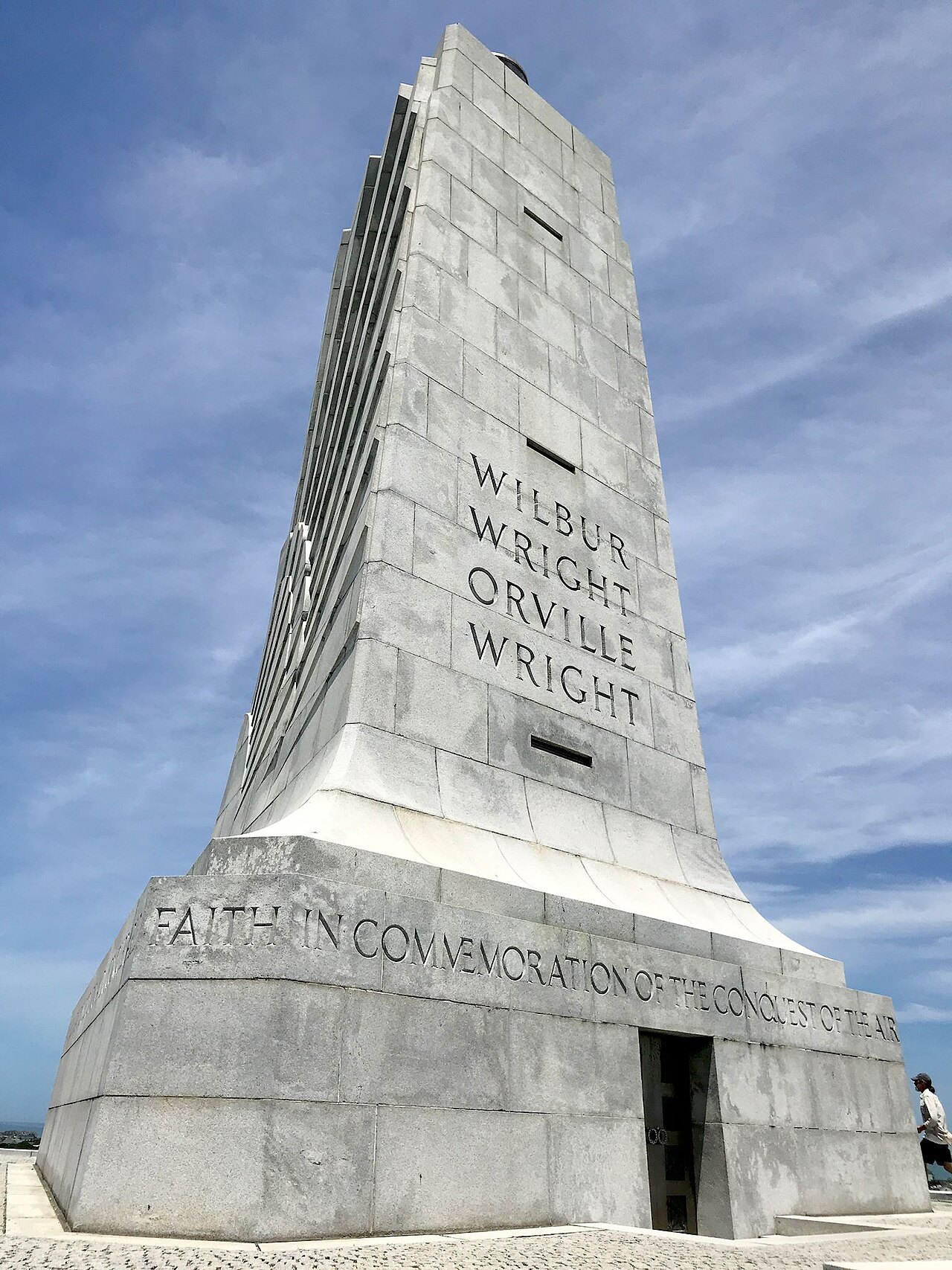
- The Memorial TowerSixty feet of North Carolina granite, dedicated in 1932 with Orville Wright present.
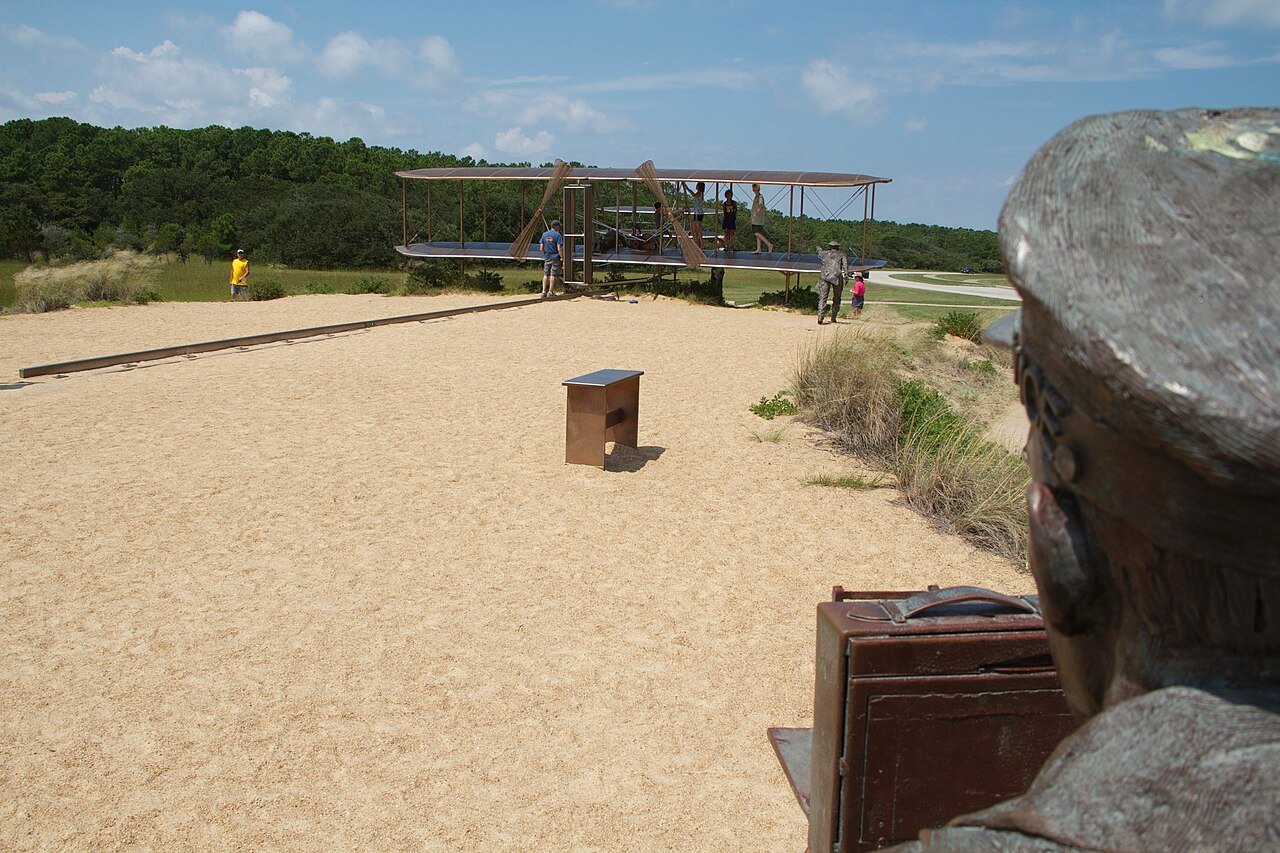
- The 1903 sculptureA full-size bronze of the moment of takeoff, with the lifesavers and the photographer beside it.
Why it matters
On December 17, 1903, on level sand at the foot of a dune on the Outer Banks, Orville Wright lifted off in a machine he and his brother Wilbur had built in Dayton, Ohio, and flew for twelve seconds. It was the first sustained, powered flight in a heavier-than-air machine, and the four flights the brothers made that morning began the age of the airplane.
The place is now the Wright Brothers National Memorial, in the town of Kill Devil Hills in Dare County. It keeps the flight field, the rebuilt camp, the dune the brothers glided from and a museum of the invention. It is the first great stop on a drive south down the Outer Banks.
Why the Outer Banks
The Wrights came to North Carolina every year from 1900 to 1903. They chose it on information from the U.S. Weather Bureau about its steady winds, and they valued its privacy: in the early twentieth century this strip of sand was far from any city, and a failure here would be seen by very few people.
For three seasons they flew gliders from the big dunes around the camp, working out how to control a machine in the air. Their last glider, of 1902, led directly to the design of the Flyer, which they built of spruce and ash and covered with a cotton muslin. No car engine suited them, so their mechanic Charlie Taylor built a light twelve-horsepower gasoline engine from scratch, driving two hand-made propellers by bicycle chains, one crossed so they turned in opposite directions.
The four flights
The first attempt came on December 14. The brothers tossed a coin, Wilbur won, and with men from the nearby life-saving station they set the launching rail on the slope of Big Kill Devil Hill. The Flyer left the rail, but Wilbur pulled up too sharply and stalled, coming down after three and a half seconds. Repairs took three days.
On December 17 the wind averaged more than 20 miles an hour, so they laid the rail on level ground near the camp and let the wind give them their airspeed. Orville took his turn at the controls. His flight, caught in one of the most famous photographs ever taken, covered 120 feet, less than the wingspan of a Boeing 747.
They made three more flights, taking turns; the fourth, by Wilbur, lasted 59 seconds and covered 852 feet over the ground. Minutes later a gust caught the parked Flyer and tumbled it end over end, and it never flew again. The brothers went home to Dayton for Christmas.
What you see on the field
The flights started from level ground near the base of the hill, and the start and the finish of each are marked with small monuments, so you can pace out the distance between the first landing and the fourth. Beside the field stand two wooden sheds built from historic photographs, the world's first airplane hangar and the brothers' living quarters.
At the far end of the park, a life-size sculpture by Stephen H. Smith, given by the state for the centennial, freezes the moment the Flyer left the rail: the Flyer and both brothers, the men from the Kill Devil Hills Life-Saving Station who helped move the machine, and John T. Daniels, who took the photograph. It is an interactive sculpture, made to be walked among.
Kill Devil Hill and the tower
The brothers made many of their glider tests on a large shifting dune that was later planted with grass to hold it in place, becoming the 90-foot Kill Devil Hill. On top stands the Memorial Tower, 60 feet of granite from a North Carolina quarry, designed by the New York firm of Rodgers and Poor and dedicated on November 19, 1932. More than 20,000 people were expected at the dedication; about a thousand came on a stormy, windy day, with Orville Wright as the guest of honor.
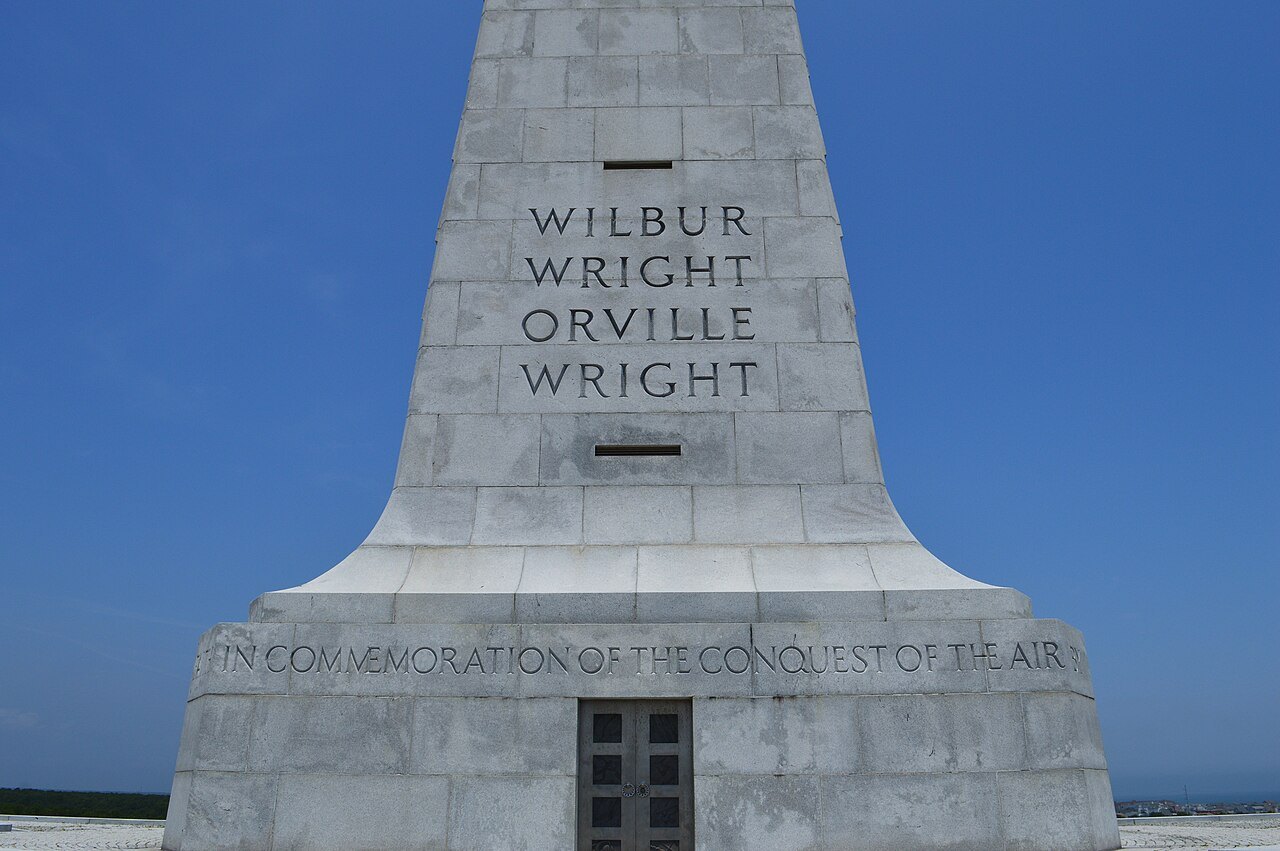
Around its base runs the inscription "in commemoration of the conquest of the air by the brothers Wilbur and Orville Wright, conceived by genius, achieved by dauntless resolution and unconquerable faith". A marine beacon like a lighthouse lamp crowns it, and its stainless steel doors carry six relief panels of the dream of flight, from Icarus and the kites the Wrights flew to the glider pioneer Otto Lilienthal.
The visitor center
The museum shows models, tools and machines from the brothers' experiments, including a reproduction of the wind tunnel they used to test wing shapes and a portion of the engine from the first flight. In one wing stands a life-size replica of the 1903 Flyer, and there is a full-scale model of the 1902 glider built under Orville Wright's direction. The original Flyer is in the National Air and Space Museum in Washington, after years in London, where Orville sent it in 1928 in a dispute with the Smithsonian.
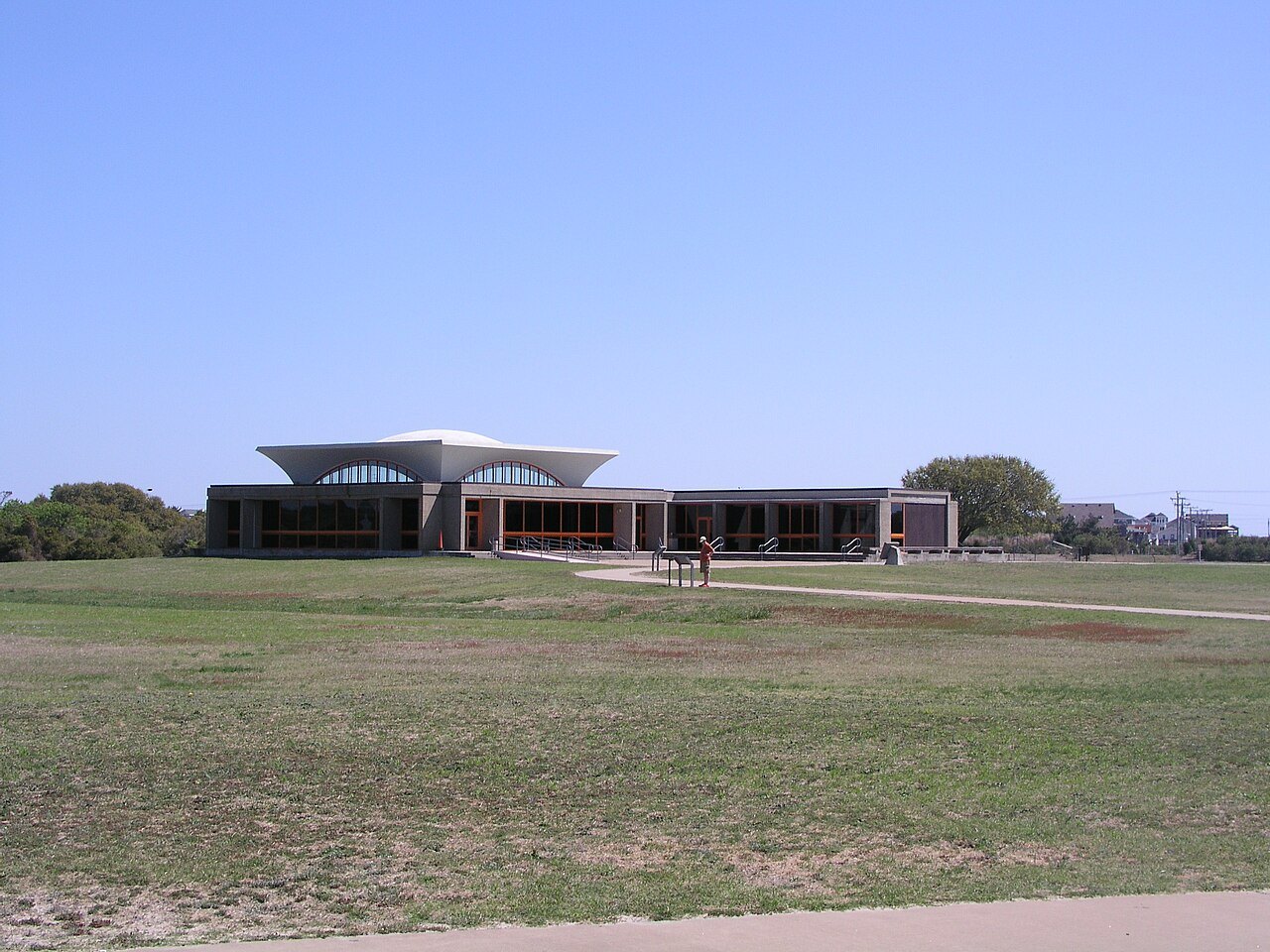
The building itself is a landmark: designed by Ehrman Mitchell and Romaldo Giurgola as the first major building of the Park Service's Mission 66 program, it broke with the rustic style of earlier park buildings and is a National Historic Landmark for its architecture.
It also displays a piece of the original Flyer's fabric and wood that Neil Armstrong carried to the Moon on Apollo 11 in 1969. On the centennial of flight in 2003, Armstrong and Buzz Aldrin came to the field, and another scrap of the Flyer's wing later flew on the Ingenuity helicopter on Mars.
How to visit
The memorial lies in Kill Devil Hills, south of Kitty Hawk, the village that gave the flights their name; the Wrights hoped to fly the four miles to Kitty Hawk village before the gust wrecked the Flyer. It is run by the National Park Service with Fort Raleigh and Cape Hatteras National Seashore, and the park's own site lists its hours, its fee and the rare days the tower can be climbed by reservation.
Walk the field first, then climb Kill Devil Hill to the tower. The tallest active dunes in the eastern United States, at Jockey's Ridge in Nags Head, are a short drive south.
Nearby